

At NI Connect, Circuit Check’s Joel Avrunin presented a growing challenge facing manufacturers worldwide: how to securely connect legacy and untrusted test systems without exposing production environments to unnecessary cybersecurity risk.
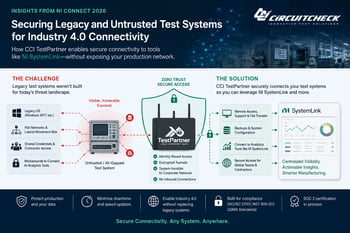
As manufacturers accelerate Industry 4.0 initiatives, tools like NI SystemLink are becoming increasingly valuable for centralized system management, remote visibility, software deployment, and test analytics. But for many organizations, connecting legacy test infrastructure to modern analytics platforms creates a difficult security dilemma.
Many production environments still rely on aging test systems running unsupported operating systems, isolated local storage, flat networks, and shared credentials. These systems were never designed for today’s connected manufacturing environment — yet they remain critical to production.
The question manufacturers now face is:
How do you gain the benefits of connected analytics and remote management without increasing cyber exposure?
Manufacturing Is Now a Prime Cyber Target
Recent cyberattacks across the manufacturing sector have demonstrated how quickly production can be disrupted through ransomware, credential compromise, and lateral movement across networks.
According to the IBM X-Force Threat Intelligence Index, manufacturing continues to rank among the most targeted industries globally. Increasingly, attackers are gaining access through valid credentials rather than traditional malware alone.
Operational technology (OT) environments are especially vulnerable because they are often managed differently than traditional IT systems. Test stations may remain in production for years or decades, making patching, upgrading, or replacing systems difficult and expensive.
At NI Connect, Joel highlighted common realities many manufacturers face today:
- Legacy Windows XP and Windows 7 systems still running in production
- Test executives that cannot support modern operating system patches
- Air-gapped or isolated test environments
- Contractors requiring secure remote access
- Manual processes to move test data into enterprise analytics systems
- Engineering teams creating “workarounds” to connect systems to tools like NI SystemLink
These environments create significant operational challenges when organizations attempt to modernize securely.
The Connectivity Challenge with Legacy Test Systems
Platforms like NI SystemLink deliver powerful capabilities for manufacturing operations:
- Centralized test monitoring
- Software and configuration management
- Asset visibility
- Data collection and analytics
- Remote system management
However, directly connecting vulnerable legacy testers to enterprise networks can introduce substantial cybersecurity risk.
Traditional remote access methods often rely on:
- Shared credentials
- Broad VPN access
- Flat VLAN architectures
- Persistent inbound connections
- Limited segmentation between systems
Once a threat actor gains access to one system, lateral movement across the manufacturing environment can become significantly easier.
At the same time, replacing legacy test infrastructure entirely is rarely practical. Many systems continue performing critical functions reliably and cannot easily be revalidated or upgraded without disrupting production.
A Secure Path to Industry 4.0 Connectivity
Joel’s NI Connect presentation focused on how CCI TestPartner addresses this challenge through a zero-trust connectivity architecture purpose-built for manufacturing test environments.
Rather than replacing existing systems, TestPartner creates a secure isolation layer around legacy and untrusted test equipment, enabling organizations to connect systems securely while minimizing exposure to the corporate network.
The approach allows manufacturers to:
- Securely integrate legacy systems with NI SystemLink and other analytics platforms
- Enable remote support and remote desktop access
- Perform backups and file transfers securely
- Reduce downtime through centralized monitoring
- Support global manufacturing operations without exposing vulnerable systems
Most importantly, test systems remain effectively invisible to unauthorized users and external attackers while still being accessible to approved personnel.
Hardware-Agnostic Security for Manufacturing Test
CCI TestPartner is designed to support the realities of modern manufacturing environments, including mixed generations of hardware and operating systems.
The platform supports:
- Legacy operating systems including Windows NT, XP, 7, and newer platforms
- Wired, Wi-Fi, LTE/5G, and industrial communication interfaces
- Existing functional test systems without requiring full replacement
- Secure connectivity across internal sites and contract manufacturers
This flexibility allows manufacturers to modernize connectivity incrementally rather than through large-scale infrastructure replacement projects.
Zero-Trust Security Built for OT Environments
A major theme throughout the NI Connect session was the importance of applying modern zero-trust principles inside operational technology environments.
CCI TestPartner uses identity-based secure access and temporary encrypted tunnels to minimize exposure and reduce lateral movement risk.
The architecture aligns with key cybersecurity standards and frameworks including:
- ISO/IEC 27001
- NIST SP 800-207
- GSMA security standards
Instead of assuming internal systems are trusted, access is tightly controlled, segmented, and granted only when needed.
Enabling Secure Manufacturing Modernization
Industry 4.0 connectivity is no longer optional. Manufacturers increasingly require centralized analytics, remote management, and enterprise-wide visibility into test operations.
Tools like NI SystemLink are helping organizations unlock those capabilities, but legacy infrastructure continues to create security and operational challenges.
CCI TestPartner provides a practical way to bridge the gap between aging test systems and modern connected manufacturing strategies — allowing organizations to securely integrate legacy environments without disrupting production.
As Joel emphasized during the NI Connect presentation, the future of manufacturing depends not only on connectivity, but on secure connectivity.